Solved 5 Op Amp LowPass Filter Consider the following op Circuit Diagram Hi, thanks for watching our video about active filters! In this video we'll walk you through:- How to design, simulate and build active opamp filters- Using
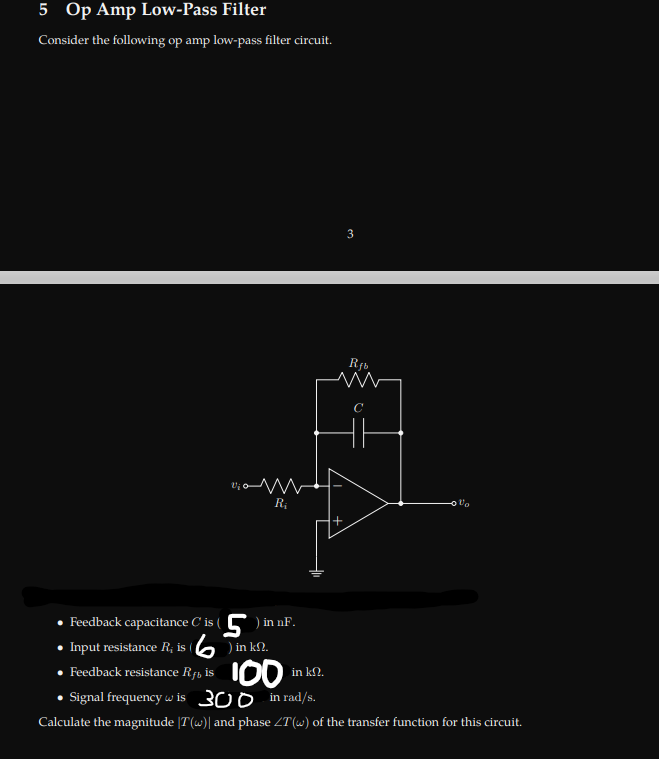
Active Low-Pass Filter Design Jim Karki AAP Precision Analog ABSTRACT This report focuses on active low-pass filter design using operational amplifiers. Low-pass filters are commonly used to implement anti-aliasing filters in data acquisition systems. Design of second-order filters is the main topic of consideration. The low pass and high pass filter can be combined into a band pass filter. In the examples below the corner frequencies were chosen to be the audio band (20Hz - 20KHz). Notice the difference in the gain outside of the pass band. The gain of the inverting amplifier continues to drop as you get farther away from the pass band.

PDF Active Low Circuit Diagram
This circuit is an op-amp-RC resonator: it produces resonance using only resistance, capacitance, and amplification. We could use this circuit to replace the inductor in a second-order RLC (resistor-inductor-capacitor) filter, but instead, we'll look at a simpler and more compact topology known as the Sallen-Key filter. Second-Order Active
Circuit diagrams and their building blocks, such as low-pass filters and op amps, may sound complex, but the basics are easy to understand and apply. Op amps are the backbone of many audio circuits, and low-pass filters are one of the most common op amp applications. 1. To design a First Order Low Pass OR a High Pass Filter using an Op-Amp and a designated capacitor as the frequency determining component. 2. Build the low-pass or high-pass filter of your design and check its frequency response. Drive the circuit with a sine wave and record input (constant) and output voltage for different frequencies.
Active Low Pass Filter Circuit Diagram
Active Low Pass Filter Example No1. Design a non-inverting active low pass filter circuit that has a gain of ten at low frequencies, a high frequency cut-off or corner frequency of 159Hz and an input impedance of 10KΩ. The voltage gain of a non-inverting operational amplifier is given as:
